
The 2026 Crop Robotics Landscape
“Where the Vision Meets the Dirt”
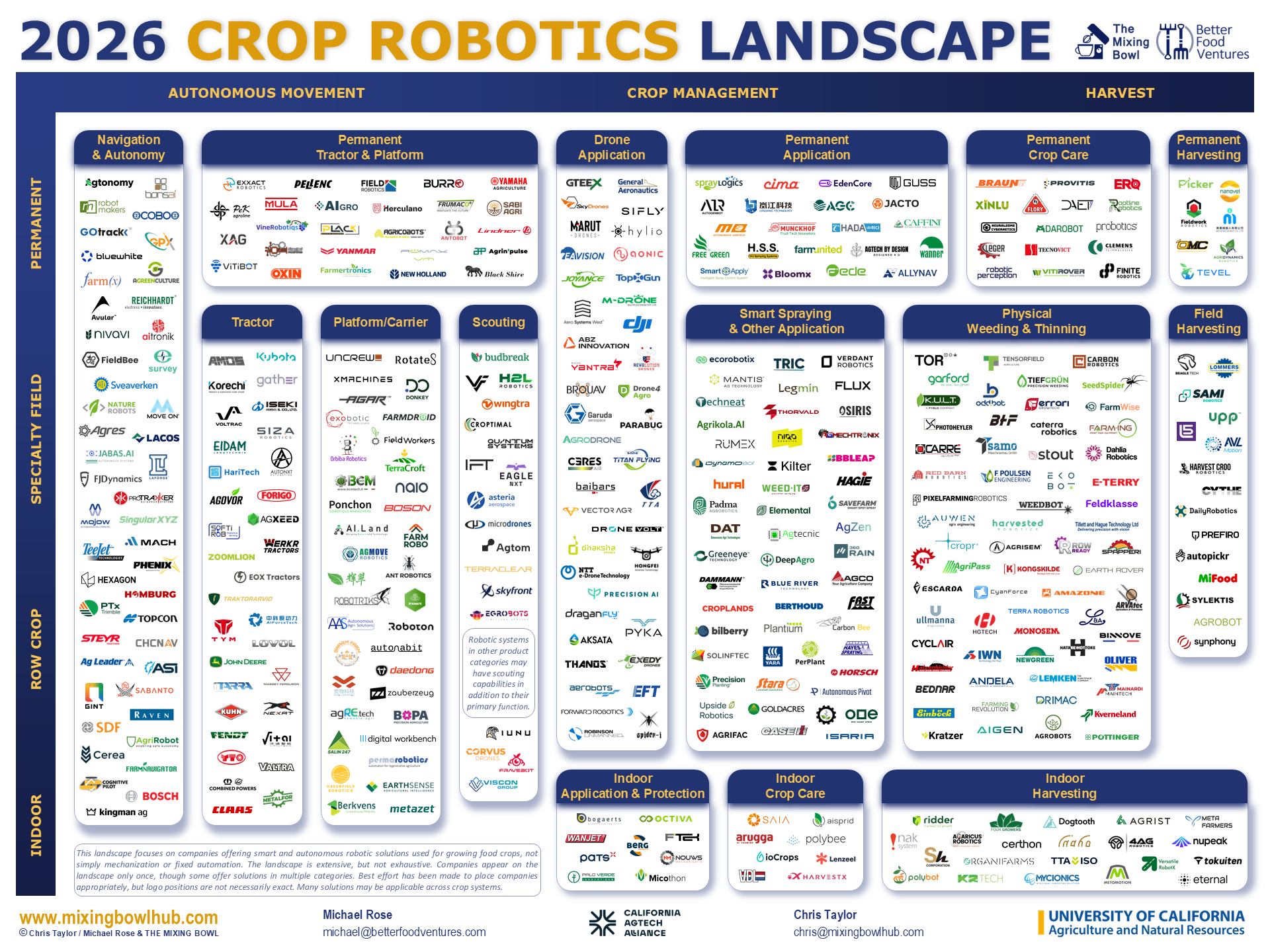
(Download a high-resolution copy of the 2026 Crop Robotic Landscape)
From 2024 to 2026: An Evolving Landscape
The Mixing Bowl’s 2026 Crop Robotics Landscape builds upon the 2024 edition to provide an expanded and refined picture of the companies creating robotic solutions for growing food crops. Over the past two years, the sector has continued to mature—new entrants have emerged, established players have sharpened their focus and strategic acquisitions have strengthened positions for the future. Progress in the field continues more slowly than many would expect, but it is not surprising given the challenges of deploying robust and cost-effective hardware-software systems suited to production agricultural environments.
This year’s landscape continues to represent the most comprehensive mapping of the crop robotics sector, capturing more than 400 companies worldwide. These companies are grouped into 15 task/product segments and arranged by major crop system and broad functional area.
The total number of companies represented increased by nearly 25 percent from 2024, but that gain conceals significant market turnover. Twenty percent of the 2024 companies exited the 2026 edition, while 36 percent of those appearing in 2026 are new entrants—an indicator of a dynamic, difficult and highly competitive innovation environment.
Geographically, Europe accounts for half of all identified companies, led by innovation clusters in The Netherlands, Germany, France and Italy. The United States leads all countries with 18% of the total—more than 40% of which are California-based—reflecting its strong alignment of agtech entrepreneurship, venture capital, and production agriculture.
Defining the Framework of the Landscape
For the purposes of this mapping, a crop robot is defined as:
“A machine that uses hardware and software to perceive its surroundings, analyze data, and take real-time action on information related to an agricultural crop function without human intervention.”
In practical terms, included companies offer autonomous navigation and/or vision and other sensor-aided precision action as shown in gold in the chart below. Such robots can take unplanned yet appropriate actions—such as navigating variable field conditions, identifying targets or adjusting inputs—in real time within the unstructured and changing environments typical of agriculture.
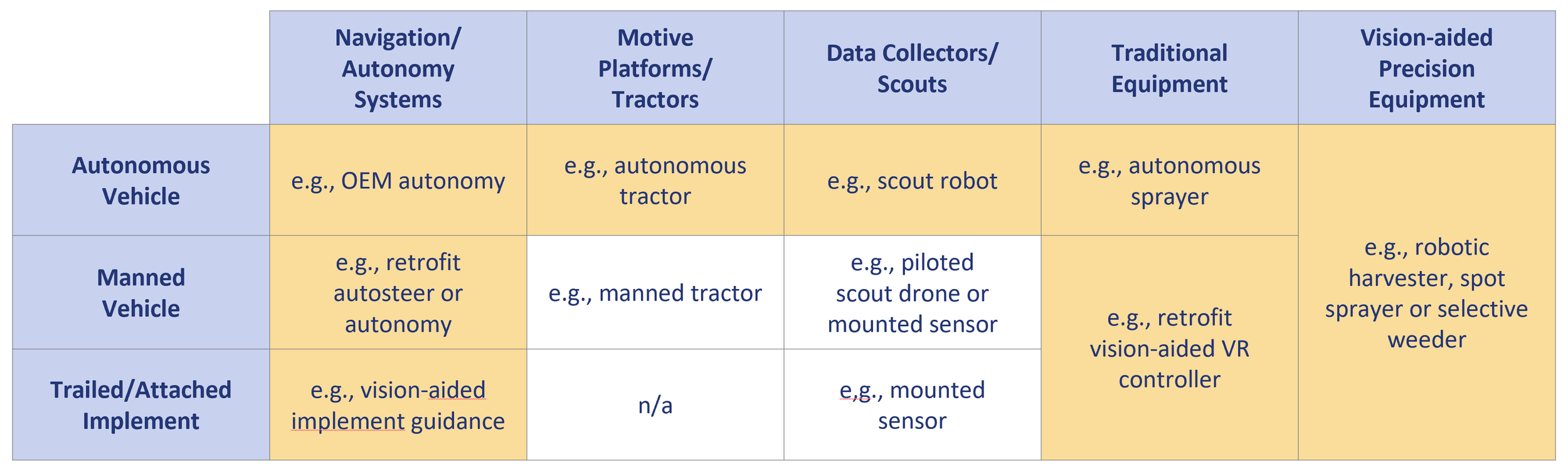
The landscape focuses on robotic solutions for growing food crops, from planting to harvest. Pre-production nursery and post-harvest solutions are not included, nor are robotics for livestock, dairy, non-food and cannabis production. Also, excluded from this landscape are:
Sensor-only or analytics-only systems (where separate action is required)
Repetitive mechanization or pre-determined automation (e.g., GPS-based prescription application, fixed-response systems) without adaptive perception or autonomy
Early-stage concepts not yet at the demonstrable-prototype stage
Non-commercial endeavors, academic and consortium research projects
Note that each company appears only once, based on its primary domain of activity and best-effort placement reflecting publicly available information and manufacturer claims. The resulting landscape is extensive though not exhaustive—its aim is to clarify rather than to completely capture a rapidly shifting industry.
The landscape is segmented vertically by crop production system: permanent specialty, field-grown specialty, broadacre row crops, and indoor. The landscape is also segmented horizontally by broad functional area: autonomous movement, crop management, and harvest. Within those functional areas are the more specific task/product segments described here:
Autonomous Movement
Navigation & Autonomy - sophisticated autosteer systems with headland turning capability and more independent vision and sensor-aided autonomous navigation systems, including retrofit kits
Tractor - autonomous tractors and implement carriers, i.e., machines that primarily provide motive power and towing capability
Platform/Carrier - multi-use autonomous platforms and tool carriers that might perform multiple tasks and/or support various tools
Permanent Tractor & Platform - autonomous tractors and multi-use platforms specifically targeting vineyards and orchards
Crop Management
Scouting - autonomous mapping and scouting robots and aerial drones; note that many robots appearing in other task/product categories have scouting capabilities in addition to their primary function
Drone Application - spraying and spreading aerial drones
Smart Spraying & Other Application - autonomous and/or vision-guided application of inputs for field crops like spraying and UV light treatment; includes autonomous rigs, spot spray implements and vision-based application control systems
Permanent Application - autonomous and/or vision-guided application of inputs like spraying and UV light treatment for permanent crops; includes autonomous rigs, selective spray implements and vision-based application control systems
Indoor Application & Protection - autonomous and/or vision-guided application of inputs for indoor crops, includes multi-row spray units and UV light treatment
Physical Weeding & Thinning - autonomous and/or vision-guided physical weeding and thinning using mechanical, laser, heat or electrical systems; includes autonomous rigs, selective implements and cultivator guidance systems
Permanent Crop Care - autonomous and/or vision-guided maintenance of the plant canopy and ground in vineyards and orchards
Indoor Crop Care - autonomous indoor deleafing, pollination, lowering, etc.
Harvest
Harvesting - crop sector-specific autonomous and/or precision harvesting robots for permanent, specialty field and indoor crops
Observations from 2026: Progress with Purpose
The 2026 Crop Robotics Landscape reveals a sector advancing steadily toward greater autonomy and intelligence across diverse production systems. The solutions continue to target areas where repetitive mechanization and fixed automation are insufficient or not practical.
Key observations from the 2026 analysis include:
Continued traction in row-crop autonomy, where navigation and guidance systems are commonly in use; more adaptable vision-aided systems emerging
Steady growth in spraying and, in particular, physical weeding, among the most active areas for both venture investment and deployment; UV light treatment deployments on the rise
A significant increase in the number of solutions targeting permanent crop production
Continued independence of sensing and control systems from equipment, particularly for navigation and precision application; nearly half of the companies in the Smart Spraying & Other Application segment are add-on sensor/controller systems, not integrated spray units
A rising pipeline of robotic platforms and carriers, including autonomous tractors and multipurpose units designed for modular attachments to improve ROI
Continued growth for scouting and application drones, with faster adoption outside the United States; new foreign models restrictions have been enacted in the US
Continued challenges in harvesting robotics; production deployments of mushroom and other indoor systems have begun and promising field crop harvesters are emerging of late, but the segment continues to lag
Crop robotics remains an early-stage, expanding market. From an investment perspective it is performing like a typical sector of emerging innovation — capital continues to flow in even as the field sorts itself out. Since our 2024 landscape, four dynamics have run in parallel: incumbents acquiring autonomy capabilities, startup-on-startup consolidation, a shakeout of the undercapitalized and sustained investment. The incumbents — Yamaha, Deere, Caterpillar, Kubota — have acquired companies or assets to add new autonomous capability or augment their existing portfolio, while a few better-funded startups have begun absorbing their peers, notably Bonsai Robotics/Farm-ng and FarmX/AMOS Power. These M&A activities are not signs of a maturing market so much as an early-stage market concentrating its capital and talent.
Funding buys the parts, people and, hopefully, the necessary time to commercialize, particularly in the hardware-heavy world of crop robotics. The following list highlights a representative set of raises of $10 million or more during the last two years:
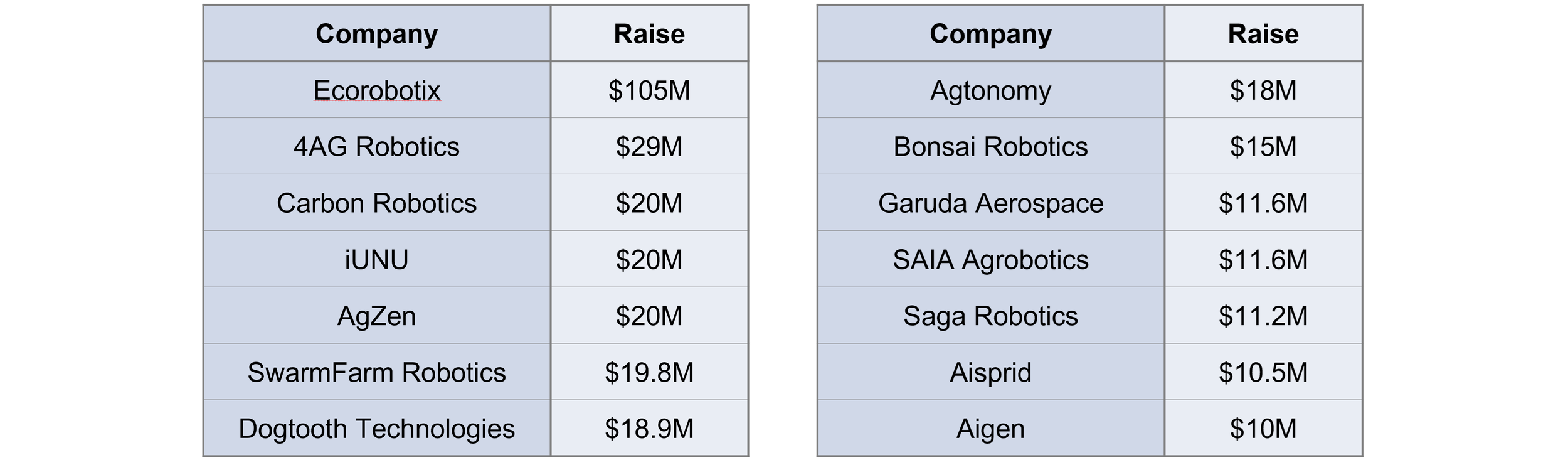
Although down from earlier highs, investments have remained steady during this latest period as companies on our 2026 landscape raised more than $600 million, from early seed rounds to raises north of $100 million.
Looking Forward: From Promise to Practice
Artificial intelligence is no doubt the most discussed and debated innovation of recent memory, but is also the most disruptive technological development across industries over the last few years. Crop robotics relies heavily on artificial intelligence, but less so on the natural-language LLMs and generative AI tools that have fueled most of the recent AI fervor. Today, the intelligence is overwhelmingly perceptual: computer vision trained on millions of field images and often fusing multiple sensor streams. This is the enabler of the real-time perception, adaptation, and reasoning needed to avoid obstacles, thin a row of lettuce, and pick a ripe strawberry or tomato. While navigation and physical manipulation may still lean on conventional methods, AI is extending into those control loops as well. Lastly, edge computing hardware on the robots provides the digital horsepower for these systems to operate reliably on the farm, even in adverse conditions.
But modern machine learning predates the current AI moment by a decade, and computer-vision models have been trained to tell a weed from a crop for some time. What continues to change are advancements in the underlying technologies, so that systems can be developed faster; can be more applicable across farm environments; be less reactive and more predictive; and can improve themselves over time. Crop robotics will continue to be a beneficiary as well as a driver of that advancement.
Since 2024, the prevalence of the term “Physical AI” has also been notable and crop robotics manufacturers have embraced it readily. This year’s landscape captures a sector in transition; it still includes basic robotic automation like GPS-based autosteer as well as sophisticated systems perhaps more worthy of the Physical AI moniker. In this regard, the functional table stakes and the bar for what qualifies as a crop robot for this landscape are likely to be raised in the future.
Persistent macro and market drivers continue to push the crop robotics sector forward. Over the past two years, several of these forces have intensified from background conditions into more active pressures:
Growers continue to report shortages of skilled seasonal workers and rising associated costs.
Input costs have increased for producers due to geopolitical impacts and raw material shortages. Higher diesel costs impact farm operations broadly while reduced fertilizer application levels by farmers in response may impact crop production output.
Pesticide and herbicide use face mounting pressure, driven by public perception as well as regulation.
Crop robots that apply inputs selectively or that can weed efficiently cut input usage in measurable terms. Crop robots that address labor challenges can also reduce employee exposure to the most repetitive and strenuous work and extreme heat, dust, and chemicals while freeing up labor for more skilled and neglected farm tasks.
The market drivers continue to increase the demand and opportunity for autonomy and precision in production agriculture while robotic offerings mature. A “robotic revolution” in agriculture is still in its early stages as crop robotics manufacturers continue to work through issues of task suitability, robustness, cost and operational fit. The market mirrors the trajectory of other emerging ag innovation arenas though: deliberate in pace, but compounding in impact as capabilities, cost structures, and trust improve. Wider adoption across the sector will depend on overcoming the commercialization headwinds and lingering regulatory barriers.
Several organizations have been working diligently to accelerate the commercialization and adoption of robotic systems for production agriculture. In California, for example, Western Growers through its case studies, innovation initiatives and policy advocacy, help viable solutions reach their grower members. Reservoir, acknowledging that there is no substitute for time in the field, has created on-farm incubators where startups and growers co-develop solutions. The California Agtech Alliance through its grant program, field demonstrations, workforce development initiatives and coordination tools endeavors to shorten the distance between innovation and adoption.
The Mixing Bowl’s 2026 Crop Robotics Landscape illustrates a field in motion: still forming, increasingly sophisticated, and foundational to the future of sustainable crop production. The path to scale remains complex, but the underlying case for crop robotics has grown harder to dismiss.
Acknowledgements
We would like to thank the California AgTech Alliance and University of California Agriculture and Natural Resources for their continued support of innovation in agriculture and of this crop robotics landscaping initiative. We would also like to acknowledge all the startups and innovators who are working tirelessly to make crop robotics a much needed reality. A special thanks to those entrepreneurs and investors that spoke with us and provided a unique view into the challenges and excitement of building a crop robotic business.
Bios
Chris Taylor is a Partner at The Mixing Bowl, where he leverages 25 years of experience in market discovery and solutions innovation across design and manufacturing, healthcare, and agricultural technology to help clients navigate the evolving landscape of food and agriculture.
Michael Rose is a Partner at The Mixing Bowl and Better Food Ventures where he brings more than 25 years immersed in new venture creation and innovation as an operating executive and investor across the Food Tech, AgTech, restaurant, Internet, and mobile sectors.
In memory of Rob Trice, colleague and friend, who left us far too soon earlier this year. Rob was founder of The Mixing Bowl and Better Food Ventures.